
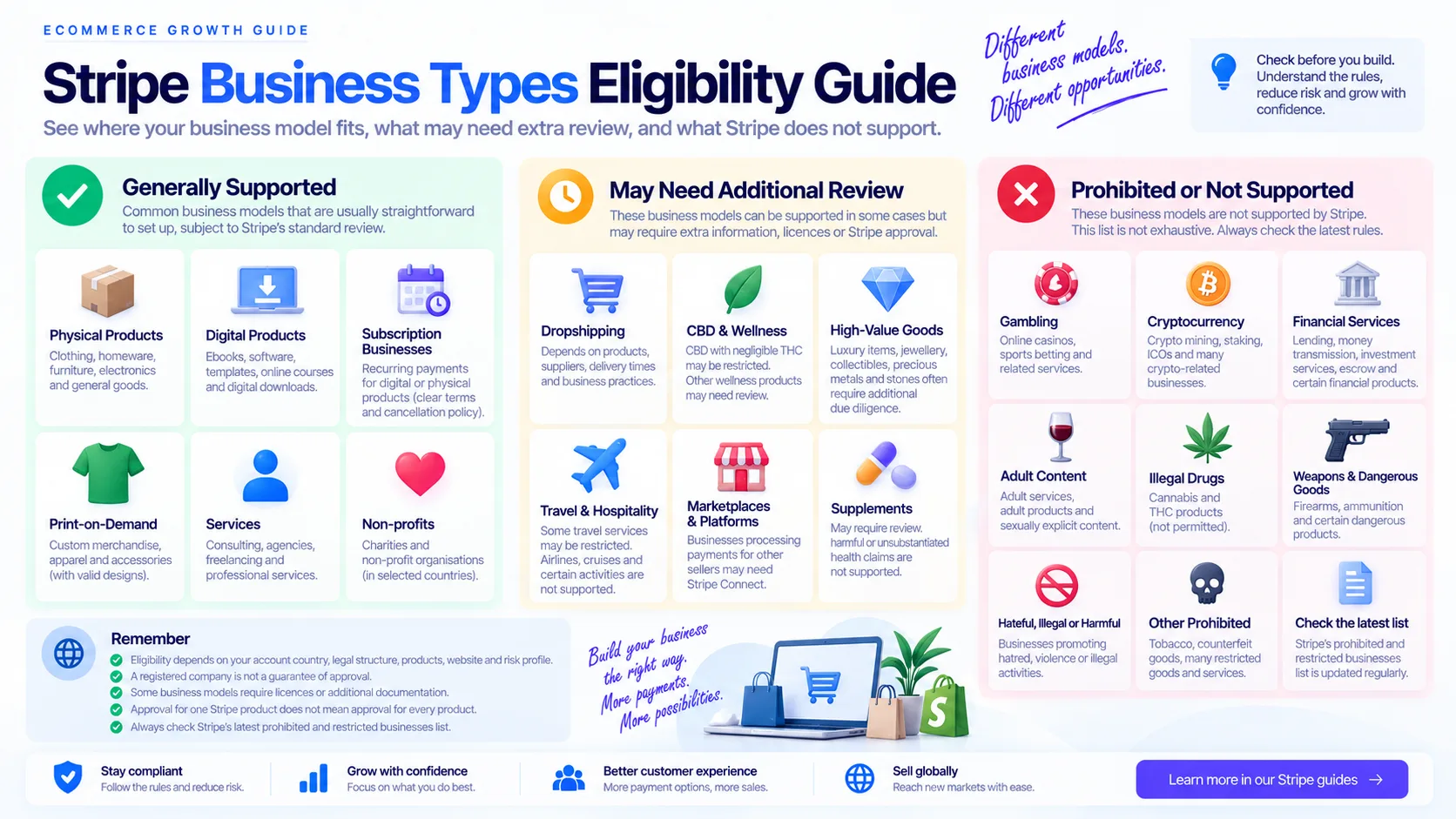
Can my type of business use Stripe?
Many businesses can use Stripe, but eligibility is not based on a single yes or no rule. Stripe has to understand where the account is established, who operates the business, what is sold, how customers pay, and whether the activity can be supported under the rules that apply to that market.
Stripe states that some businesses cannot be supported because of laws, regulations, card network requirements, banking partner policies and financial services obligations. Always check Stripe's current official rules because eligibility can change.
- Stripe account country
- Legal business structure
- Products or services sold
- Business model
- Website and customer experience
- Where the business operates
- How payments are collected
- Regulatory requirements
- Financial and payment risk
- Stripe prohibited and restricted business rules
If these fundamentals are unclear, resolve them before accepting live payments.
Stripe eligibility is about more than company registration.
A merchant may have a legitimate UK Ltd, US LLC, Dutch BV, sole trader business or partnership and still operate a business model that requires additional review or cannot be supported.
Legal business does not automatically mean Stripe-supported business.
Legal structure answers "Who operates this business?" Business model answers "What does this business actually do?" Stripe needs to understand both.
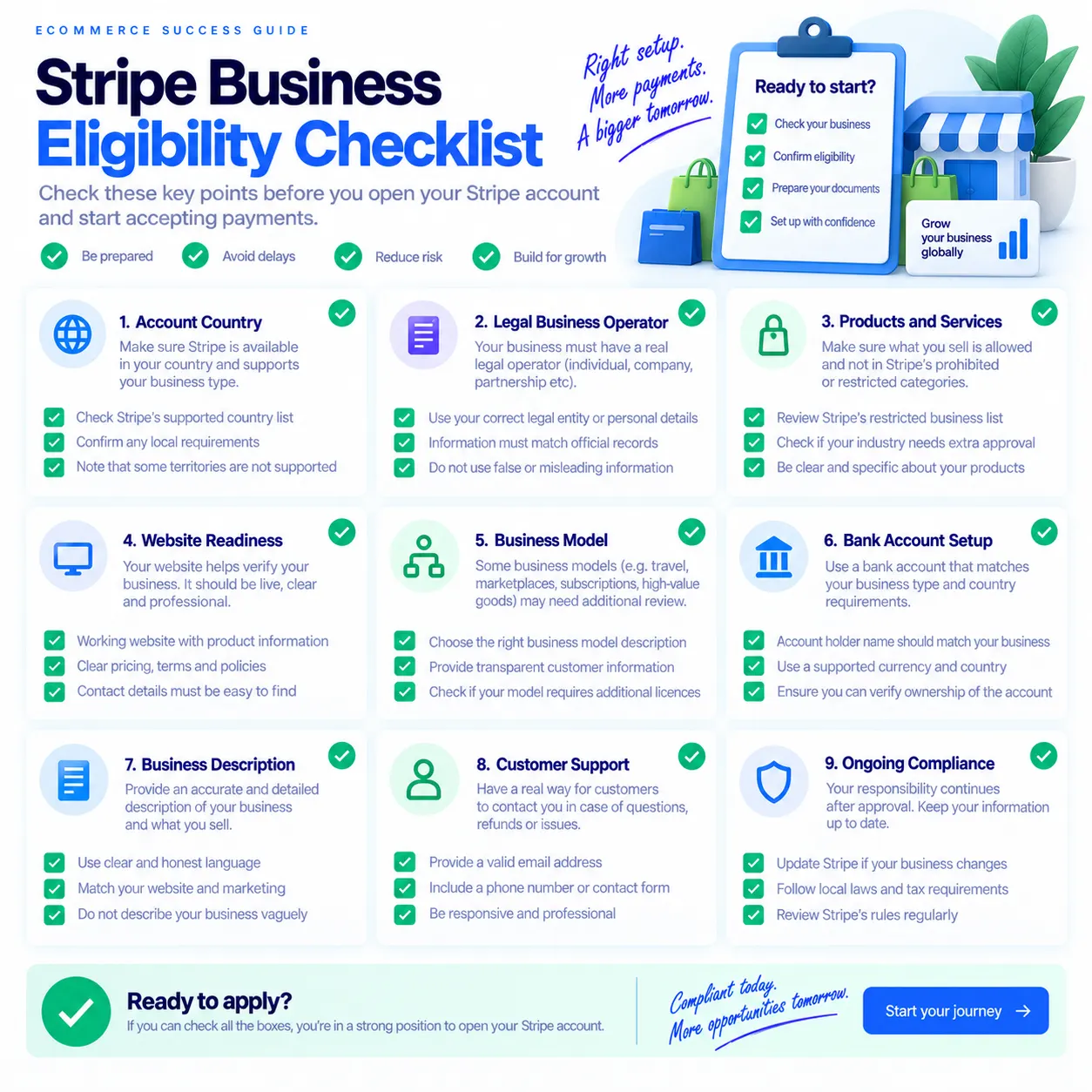
Basic Stripe business eligibility checklist.
Before opening or scaling a Stripe account, merchants should make the basic account story clear enough for a reviewer, customer and payment partner to understand.
- Is Stripe available in the account country?
- Is there a genuine legal operator?
- Can Stripe understand what the business sells?
- Is the website operational?
- Is the banking setup appropriate?
- Is the industry supported?
- Is the information accurate?
- Are prohibited and restricted business rules checked?
If these fundamentals are unclear, resolve them before accepting live payments.
Business structure vs business type.
Business structure describes the legal form, such as sole trader, sole proprietor, UK Ltd, US LLC, Dutch BV, partnership, corporation or non-profit.
Business type or business model describes what the business actually does, such as fashion e-commerce, furniture retail, dropshipping, print-on-demand, digital products, subscription services, travel bookings, marketplaces, CBD retail, financial services, online education or high-value goods.
A UK Ltd selling ordinary furniture and a UK Ltd operating a financial service are both limited companies, but their payment-processing eligibility can be very different.
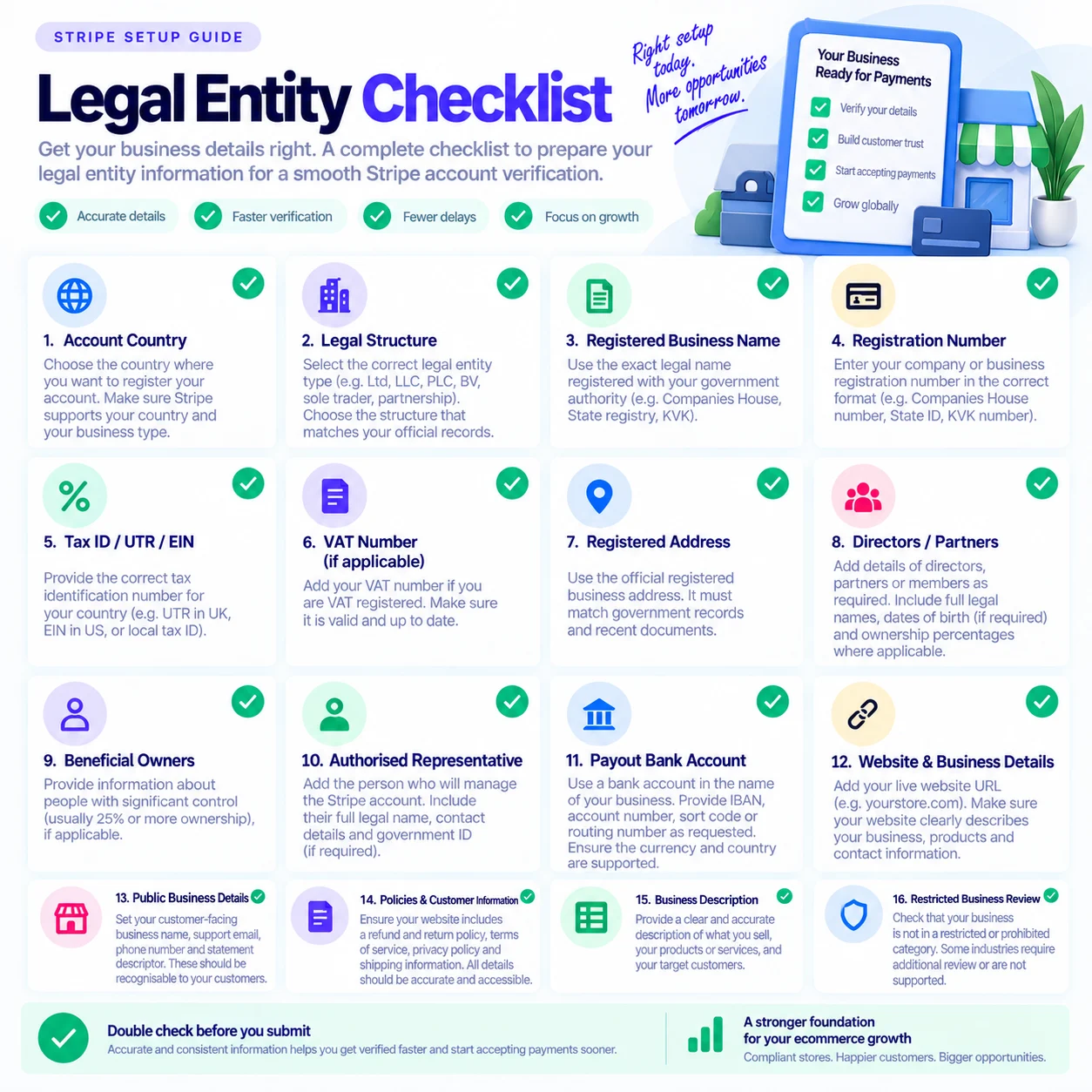
Business structures Stripe commonly encounters.
Keep the structure high level and choose the option that actually represents the business. Do not select another entity type because it seems easier for approval.
Business structure: Sole trader / sole proprietor
Typical example: Individual running their own e-commerce business
Business structure: Limited company
Typical example: UK Ltd
Business structure: Limited liability company
Typical example: US LLC
Business structure: Private limited company
Typical example: Dutch BV
Business structure: Partnership
Typical example: Business operated by partners
Business structure: Limited liability partnership
Typical example: UK LLP
Business structure: Corporation
Typical example: US corporation
Business structure: Public company
Typical example: UK PLC / Dutch NV
Business structure: Non-profit organisation
Typical example: Eligible charities or non-profits depending on jurisdiction and activity
Business structure: Platform / marketplace
Typical example: May require a different Stripe structure such as Connect
Choose the structure that actually represents the business. Do not select another entity type because it seems easier for approval.
Do not process for another undisclosed merchant.
Do not use a normal Stripe merchant account as a payment-processing service for another business.
For example, a friend cannot get a payment account and asks to process through your Stripe account. That arrangement is not the same as your own disclosed business accepting payments.
Stripe prohibits facilitating transactions on behalf of another undisclosed merchant or for products and services not disclosed in the account application.
One Stripe product approval does not approve everything.
A merchant might receive approval to use one Stripe service. That does not necessarily mean approval for every other Stripe financial product.
If the business requires specialised Stripe products, verify eligibility for the actual services intended rather than assuming one approval covers the entire future payment stack.
Country eligibility matters.
Customer location and Stripe account country are different concepts. A store can sell to international customers while the Stripe account remains established in a specific supported country.
Stripe's global availability list changes. Some markets are preview or extended network. Merchants should check the current country list before incorporating or setting up banking arrangements for Stripe.
Can I open Stripe in another country?
Possibly, but the merchant generally needs the appropriate local setup. Do not simply choose another Stripe country because the actual country is unsupported.
- Legal entity registered in that country
- Tax ID
- Physical location where mail can be received
- Telephone number
- Government-issued identification
- Working website
- Appropriate physical bank account
- Stripe availability in that country
Do not simply choose another Stripe country because the actual country is unsupported.
US Stripe accounts have specific requirements.
For US accounts, Stripe support guidance says registered businesses must be registered in the US even if operations occur elsewhere.
Merchants may need to provide a physical business address, and PO boxes may not be accepted for the main business activity address. Stripe may verify legal entity name, entity type, EIN, SSN or ITIN and business address.
A US LLC certificate alone does not guarantee Stripe account eligibility.
Your website is part of your business eligibility story.
Stripe should be able to compare the Stripe business description, website, products, policies, customer-facing brand and legal operator.
Good example: Stripe description: Home furniture retailer. Website: Furniture and home accessories. Checkout: Nordic Home. Legal operator: ABC E-commerce Ltd.
Problem example: Stripe description: Software services. Website: Luxury watches. Checkout: Different brand. Legal pages: Another company.
Your bank account should fit the business.
For a registered company, payout banking should make sense for that company and Stripe's country requirements. For sole traders or individual businesses, ownership requirements may differ by country.
Clean payment flow: Customer -> Your business -> Your Stripe account -> Appropriate payout account.
Bad flow: Customer -> Business A -> Stripe account belonging to Business B -> Friend's bank account.
What if my business changes after Stripe approval?
A clothing store adding supplements, a store moving from low-ticket products to expensive luxury goods, a merchant changing from selling its own products to operating a marketplace, or a business entering a regulated product category can all be meaningful changes to the business Stripe originally understood.
Update information instead of keeping an outdated description.
Stripe can review eligibility after processing starts.
Do not think of eligibility as signup, approval, permanent approval forever.
Products, countries, volumes, ownership, risk and regulations can change. Keep Stripe account details and business operations aligned.
E-commerce business models: what merchants should consider.
There is no single risk profile called e-commerce. Two Shopify stores can use the same platform but operate very different businesses.
Physical products.
Conventional physical-product e-commerce can be relatively straightforward if products are permitted, the website is clear and fulfilment is reliable.
Product category still matters. A low-risk catalogue and a high-value, regulated or restricted catalogue can require very different review.
Digital products.
Digital merchants should explain what customers receive, when they receive it, how access works, pricing, cancellation and refund conditions, customer support and delivery or fulfilment.
Avoid vague descriptions such as "digital e-commerce". The reviewer needs to understand the actual product and customer experience.
Subscription businesses.
Subscription models can be legitimate, but merchants must be clear about what customers subscribe to, how much they pay, how often they are charged, how cancellation works, whether a trial becomes paid and the refund policy.
Unclear negative-option or deceptive trial models can create serious eligibility and risk issues.
Dropshipping businesses.
Dropshipping should not be treated as a universal yes or no category. The actual business and jurisdiction matter.
Avoid broad claims such as Stripe always supports dropshipping or Stripe bans dropshipping.
- What is sold
- Where products originate
- Delivery times
- Product quality
- Customer expectations
- Supplier reliability
- Intellectual property rights
- Refund handling
- Business location
- Target countries
Print-on-demand businesses.
Normal print-on-demand businesses selling legitimate merchandise may look similar to other fulfilment models.
Using print-on-demand technology does not remove responsibility for intellectual property compliance.
- Copyright
- Trademarks
- Brand authorisation
- Delivery times
- Returns
- Supplier reliability
- Product quality
High-ticket e-commerce.
Higher order values can create greater financial exposure. Some high-value categories, precious metals and stones may fall into restricted categories requiring additional due diligence.
CBD businesses.
CBD is a good example of why merchants must check current rules. Do not label CBD simply as supported or prohibited without examining the exact product, THC content, jurisdiction and Stripe's current rules.
If the business falls into this area, obtain clarification before processing.
Supplements and nutraceuticals.
Not every supplement business is treated the same. Merchants should review product ingredients, health claims, marketing claims, local regulation, required licences and target markets.
Do not disguise the nature of products as general wellness products if that is inaccurate.
Travel businesses.
Travel eligibility depends on the exact activity and payment flow.
"Travel business" is not specific enough. Merchants should identify exactly what is being sold and how customer funds flow.
Financial services.
Financial services require particular care. Lending, investment services, currency exchange, money transmission, escrow, bank account funding, financial advice and brokerage activities may require review or be restricted or prohibited.
Do not register a financial services business as "business consulting" if that is not accurate.
Cryptocurrency businesses.
Crypto eligibility depends on the exact product. Some crypto-related activities can be prohibited while some limited-availability services may require engagement with Stripe.
Check current Stripe crypto supportability before building around Stripe.
Marketplaces and platforms.
Business A: Nordic Home sells its own furniture to customers. This is a conventional merchant relationship.
Business B: Nordic Marketplace lets many independent sellers sell to customers while the platform collects or routes payments. This is structurally different.
Marketplaces and platforms may need a product architecture such as Stripe Connect, subject to Stripe's requirements, rather than treating every payment as the platform's own e-commerce revenue.
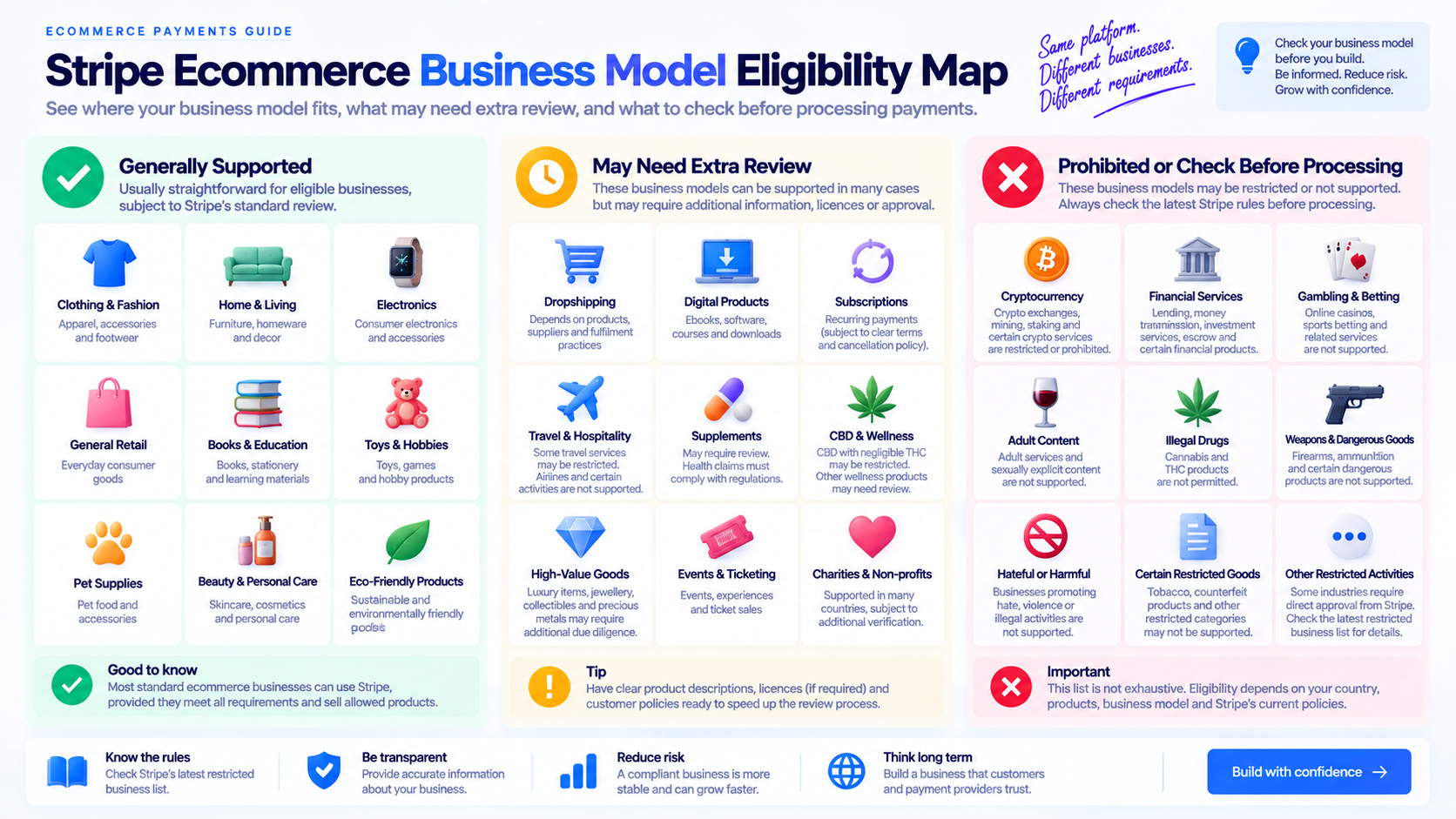
Supported, restricted and prohibited: understand the difference.
Merchants should separate generally supportable business models from restricted categories and prohibited activities before processing live payments.
Generally supportable business model
Activity does not appear to fall into a known restricted or prohibited category, subject to review and all other Stripe requirements. Approval is not guaranteed.
Restricted business
Business category requires additional due diligence before Stripe confirms support. Stripe may request licences, documentation or more detail.
Prohibited business
Activity cannot use Stripe services under the applicable prohibition.
Some restrictions are country-specific. Always check the current list rather than relying on old forum posts or old articles.
Merchant eligibility decision guide.
If the business appears outside restricted or prohibited categories
Continue with normal onboarding, but still provide accurate information and complete verification.
If the business appears in a restricted category
Check before processing. Stripe may require additional due diligence, licences, documentation or explicit approval.
If the exact activity appears prohibited
Do not reclassify or disguise the activity. Consider providers that legitimately support the industry.
If unsure
Ask Stripe before launching live payments, especially for regulated, unusual or hybrid models.
Business type eligibility checklist.
Use this checklist before opening, activating or scaling a Stripe account for an e-commerce business.
- Is Stripe available in my account country?
- Is my business genuinely established under the structure I selected?
- Does my Stripe description accurately explain what I sell?
- Does my website show the same products and services?
- Is the business model permitted?
- Have I checked Stripe's latest restricted business list?
- Are there country-specific restrictions for my industry?
- Do I need additional licences?
- Does my business require Stripe's prior approval?
- Does my particular Stripe product require separate approval?
- Is my website live and complete?
- Are products clearly described?
- Are prices transparent?
- Are refund and cancellation rules clear?
- Is customer support accessible?
- Is my payout banking setup appropriate?
- Am I processing only for my own disclosed business?
- If I operate a marketplace, have I considered the correct platform or payment architecture?
- Have I disclosed regulated or higher-risk products accurately?
- Will I update Stripe if the business materially changes?
If you cannot confidently answer one of these questions, investigate it before processing live transactions.
FAQ: Stripe business types and eligibility
Can any business open a Stripe account?
No. Stripe supports many business types, but eligibility depends on factors including account country, products, business model and Stripe's restricted business rules. Some businesses require additional due diligence and others are prohibited.
Can a sole trader use Stripe?
Sole traders and sole proprietors can use Stripe in supported markets where Stripe offers that business structure, subject to verification and business eligibility. Exact onboarding requirements depend on the account country.
Can an LLC or limited company use Stripe?
Yes, these are common business structures for Stripe accounts in applicable jurisdictions. However, having an LLC or limited company does not automatically make the underlying products or business model eligible.
Can dropshipping businesses use Stripe?
Eligibility depends on the actual products, jurisdiction, fulfilment model and business practices. Merchants should check Stripe's current rules rather than relying on a blanket yes or no answer.
Can CBD businesses use Stripe?
It depends on the exact product, THC content, jurisdiction and Stripe's current rules. Some CBD-related products may require additional review while cannabis-related activities can be prohibited.
Can supplement businesses use Stripe?
It depends on the products and claims. Businesses selling unsafe pseudo-pharmaceuticals or nutraceuticals making harmful claims can create serious eligibility issues.
Can high-ticket businesses use Stripe?
The specific product matters. Some high-value goods, precious metals and stones may require additional due diligence.
Can I use Stripe if my country is not supported?
Do not simply select a different country. Stripe publishes its supported country list, and opening an account in another country generally requires an appropriate local entity and other local requirements.
Can I process payments for another business through my Stripe account?
No, not as an undisclosed merchant arrangement. Your Stripe account should process payments for the business and products disclosed in the account application.
Does Stripe approval guarantee my account will stay open?
No. Eligibility and risk can be reviewed after activation. Keep business information current and continue meeting Stripe's requirements.
The key principle.
The question is not simply: Do I have a registered company?
The better question is: Does Stripe support the business I actually operate, in the country where my account is established, for the products and Stripe services I intend to use?
A UK Ltd, US LLC or Dutch BV is a legal structure. It does not tell Stripe what you sell.
Your products, services, fulfilment model, customer relationships, countries, payment flow and regulatory requirements determine the wider business model.
Be accurate from the beginning. Do not hide restricted products. Do not describe a regulated business vaguely. Do not process for undisclosed third parties. Do not assume an approval applies permanently or to every Stripe product.
Whenever your business materially changes, make sure the information provided to Stripe continues to represent the business you actually operate.
This guide is for general merchant education and is not legal, financial, tax or compliance advice. Always review Stripe's official documentation and the requirements shown in your own Stripe account. Confirm legal or tax questions with the appropriate authority or a qualified adviser.
Official Stripe resources
Review Stripe documentation directly for the current rules that apply to your market, business type and account setup.